Showing posts with label Literary Landmarks of New York City. Show all posts

Thursday, October 16, 2008

Photos from the October 14th Teen Reading at the NYPL!

JEFFERSON MARKET BRANCH LIBRARY

Many amazing things happened at the last reading:

1) We changed locations last-minute to the New York Public Library Jefferson Market Branch (from Barnes & Noble West Village) and we started almost on time.


2) As our readers read their prose, memoirs, poetry, and scripts, the audience (of about 55) laughed and gasped at all the right moments.


3) It turns out that our young literati are phenomenal actors, too. It was incredible to hear Lena Beckenstein's script read aloud so... dramatically. :-)


4) The editors of the forthcoming teen anthology of six-word memoirs came and answered all pressing questions, relaying info such as:


a) the book will be published sometime over the next year


b) emails will go out within a couple of months to all those whose memoirs they choose to include


c) and of course, you'll get a free book along with it!


5) The "Six-Word Memoir Blast" inspired the writing of more six-word memoirs... which can still be submitted to the website --and can still be featured and commented upon by others.


Read more!

Saturday, July 7, 2007

Literary Landmarks of New York: The White Horse Tavern


In New York, it is incredibly easy to locate literary landmarks because of the sheer number of poets, playwrights and novelists who have called the city home. A writer's life can be a very solitary one, so many men and women wrote or relaxed with friends in cafés and bars -- to draw inspiration from the everyday people and goings-on, perhaps, or maybe just to keep from feeling too lonely.


One such little place, located on the corner of Hudson Street and 11th Street in Greenwich Village, is the White Horse Tavern. It was built in 1880 and was initially frequented by longshoremen--the men who worked loading and unloading ships at the seaports a little further downtown.

Despite its old-fashioned, traditional decor, the White Horse became the hotspot for the progressive, experimental minds of the Beat era and members of the folk/hippy movement: Jack Kerouac, Norman Mailer, and Bob Dylan (not necessarily literary, but a poet in his own right) were all regulars. In fact, legend has it that Kerouac visited so often that a fellow drinker once scrawled "KEROUAC GO HOME!" on the bathroom mirror. Hunter S. Thompson, James Baldwin, Anais Nin and Allen Ginsberg were among the many who would gather there, sometimes in groups or pairs and sometimes alone. The New York School poets, including Frank O'Hara and John Ashbery, also dropped by the White Horse on occasion. Sadly, the most lasting legacy of the White Horse Tavern is the fact that it is the bar in which Dylan Thomas, the Welsh poet, overdosed on alcohol and died. However, the White Horse Tavern remains open, and many tourists visit it every year--some on the New Ensemble Theatre Company's tour of literary bars in Greenwhich Village, and others alone--to catch perhaps a little bit of the magic that surely remains within its walls, the remnants of a once-thriving, explosive and creative place.

Read more!

Saturday, June 30, 2007

Literary Landmarks of New York: The Algonquin Hotel

Communities like WritopiaLabs show us just how much New York can--and does--inspire writers and artists of all ages and all interests. With its vibrancy, diversity and unpredictability, New York has been the birthplace of so much creative expression that it's almost impossible to quantify it; Arthur Miller, Mel Brooks, Doris Kearns Goodwin, Madeleine L'Engle, Herman Melville, and Chaim Potok all spent significant parts of their careers living here, to name just a few. As a result, New York is filled with "literary landmarks"--places where writers lived, worked, met to share ideas, or simply found inspiration. Some are better known than others: children's-book character Eloise famously wreaked havoc in the Plaza, and Henry James' Washington Square was set in the downtown New York neighborhood of the same name. However, many places have slipped out of New York's collective memory, despite the fact that they were instrumental in the development of our city's cultural history.

The first place that I found out about in my quest to uncover New York's literary landmarks is the Algonquin Hotel.

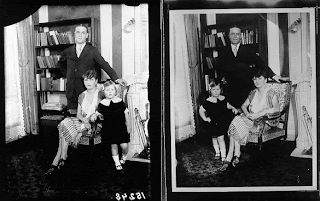
Located on West 44th St. in Manhattan, the Algonquin is an unassuming, albeit luxurious hotel, with very little to outwardly distinguish it from the many such hotels in the neighborhood. However, what sets it apart is not any singular characteristic, but rather, the history that occurred within its walls. In 1919, a series of lunchtime meetings began in the hotel, which were called the "Algonquin Round Table." The Round Table, which later came to be known as the "Vicious Circle" for its members' biting wit, was a meeting-place for New York journalists, authors, actors and publishers, such as John Barrymore, George S. Kaufman, Alexander Woollcott and Dorothy Parker; such lunches occurred pretty much daily between 1919 and 1929. The ideas, tastes, and themes of that booming decade--one which would prove among the most culturally prolific in American history--were created and dissected in Round Table meetings. Ultimately, all of the literary greats of the Roaring Twenties, including F. Scott Fitzgerald, would spend some time at the Algonquin, exchanging "bon mots" about society, literature, and anything they saw fit. In fact, Fitzgerald had a family portrait taken in the lobby of the Algonquin near the end of his life. He could not have chosen a more appropriate place.
-Emma
Image
I am a sixteen-year-old high school student, about to enter my final year of high school, looking to improve my writing and to meet and learn from people who are trying to do the same. I have loved books--and loved writing--ever since I was quite wee, and find in Writopia the kind of warm, welcoming writers' community that I think is vital to keeping that love of words and that creativity alive and thriving.
Read more!